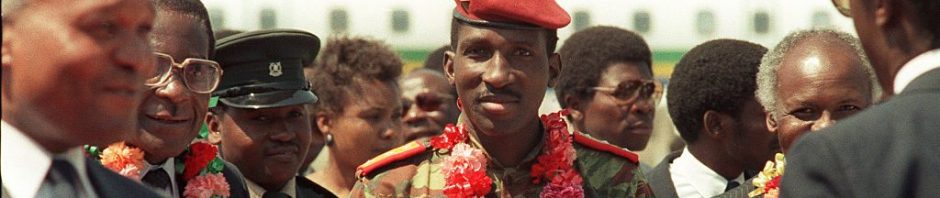
Please read Sankara’s speeches “Building a New Society,” “Imperialism is the Arsonist of our Forests and Savannas” and “A United Front Against Debt (1987)” and watch the short film Thomas Sankara: The Upright Man (2006). You can find the live streaming link to the film, which is available through the ASU library, on the course website under topic “Week Eight.”
Here is a link to an electronic copy of the book Thomas Sankara Speaks, which includes the three speeches.
Post a short reflection on how the film and Sankara’s speeches may enable us to think about the following questions: What is the essence of neocolonialism, of decolonization, and of anti-imperialist struggle, in Sankara’s view? What can we learn from Sankara’s revolution in terms of building more sustainable, resilient and just societies in response to the current global crisis?
 SD 3800 Voices in Sustainable Development
After listening to and reading speeches by Thomas Sankara and watching the documentary “The Upright Man,” I believe that Sankara’s perspective on decolonization centers most importantly on the aspect of centralized production and consumption, highlighting the labor of the proletariat and the equal rights of individuals to contribute in society. Neocolonialism, as Sankara describes it, stems from economic enforcement of power dynamics, in the form of debt and import/ export inequalities. Neocolonialism is both an internal struggle, as the bourgeoisie who found success during colonialism try to continue their industrial ventures, and an external struggle, as foreign banks from colonial times collect debt repayments. Sankara opens his speech “A United Front Against the Debt” (delivered 1987 to AUOO, Addis Ababa) in an accusing and directed manner, declaring: “Those who lent us the money were those who colonized us. They were the same people who ran our states and our economies.” It is in this speech that he connects the notion of neocolonialism to foreign debt, and connects the inequality of import-heavy economies to a lack of internal production of goods. As part of his governance, he encouraged the consumption of local goods, produced from domestically grown cotton. He comes back to the idea of utilizing domestic labor in his speech on building a new society (published 1983 by the Upper Volta Ministry of Information). Speaking similarly to other Marxist/ communist politicians, he recognizes the value of proletariat labor in building a country. On the proletariat, Sankara says “ To the extent that the revolution can provide them something useful to do, they can become its fervent defenders,” pointing to the role that physical labor has in national wealth, and the role that national programs have in maintaining common welfare. (This rousing of proletariat labor is not without its downfalls, as noted by Fanon (1960), in The Pitfalls of National Consciousness, mentioning how labor can be exploited in the name of national success and through state apparatuses). Sankara can be said to highlight the contributions of a broad society, and was appreciated for the relevance given to women’s rights. He makes a distinct point that “women’s emancipation…Is not a mechanical equality between men and women, acquiring habits recognised as male – drinking, smoking, and wearing pants… The genuine emancipation of women is one that entrusts responsibilities to women, that involves them in productive activity and in the different fights the people face,” (1983). While recognizing the importance of a person based on labor and productivity raises concerns, rates of employment, education, and job security can operate as indicators of welfare in society. It is these indicators that Sankara recognizes, while stressing the importance of being in decision-making fields, in order to support the emancipation of women in Burkina Faso. Sankara continually stands in support of domestic labor and self governance as a way to achieve decolonization, now in generally economic terms, and also as a way to benefit the people, as problems in welfare stem from dependence and subordination to foreign powers.
-David Bass
Throughout the film, Sankara made it clear that neocolonialism was the most destructive part of his country. Neocolonialism to him was the debt that Africa faced, a debt that could not be paid off and in return would continue to give power to western countries. Burkina Faso’s reliance on other countries he said to be counter productive, and made it easy for imperialism to be systemically everywhere. This reliance on other places caused the other countries to benefit where Burkina Faso would lose. Sankara mentions in the film that imperialism is in the rice and beans that they eat because it did not come from their land. Sankara had many goals to begin to decolonize Africa and Burkina Faso, and that started with the local creation of produce and materials. An example of this was the Faso Dan Fani, a type of clothing that was created by local craftsmen, and every Burkinabé resident was asked to wear the locally made clothes instead of ones that were imported from America.
Autonomy was Sankara’s greatest goal to fight against imperialism, and this can be used in the current global crisis as well. Local production and power of one’s own land allows for greater opportunities to grow a strong, local economy. A large fight for Sankara during his time as president was to reforest the land that was quickly becoming a desert, and as seen in the film he planted millions of trees as a way to move against desertification. This was not just an environmental move but a political one as well in order to explain how the environment and politics will always be interrelated. In Sankara’s speech “Imperialism is the Arsonist” he states “We are not against progress, but we do not want progress that is anarchic and criminally neglects the rights of others. We therefore wish to affirm that the battle against the encroachment of the desert is a battle to establish a balance between man, nature, and society. As such it is a political battle above all, and not an act of fate,” (Sankara pg 275). Sankara wishes to better Burkina Faso, but not if it means people lose their rights or the environment is harmed in the process. It is not necessary to follow Sankaras every step, but in today’s climate it is important that every person and ecosystem is considered on the terms of new development.
Brynne Dieterle
After reading the speeches by Thomas Sankara, watching the film about him, learning about his rise to power, what he stood for, what he fought for, and what he valued most, I’m questioning why I’ve only heard his name once or twice before today. A possible reason for this could be the way he died. As described in the film “The Upright Man” Sankara was betrayed by his best friends, caught by surprise, shot, killed, then buried in the middle of the night “like a dog” (46:43). Then, to make matters worse, his best friend ruined his reputation, essentially reverses all of Sankara’s efforts by becoming cooperative and friendly with France again, and destroying any traces of Sankara’s power. This is an absolute injustice. Sankara spent his few years in power absolutely transforming Africa and Burkina Faso in a way that spoke to the whole world.
In Sankaras view, neocolonialism is the root of all issues. In Manichaenistic terms, in terms of good and evil, neocolonialism is evil. As he states clearly in his “Building a New Society” speech, the 23 years of neocolonialsim that his people endured was “paradise for some and hell for the rest” (p. 87 in the book). Paradise for the colonists and the rich, hell for the colonized and the poor. Furthermore, when discussing the debt owed by Burkina Faso at the organization of African Unity Conference in his speech “A united front against the debt”, Sankara blatantly blames neocolonialism for the debt. He states, “this debt has nothing to do with us” (p. 403). Why should the Burkinabe have to pay for a debt they didn’t cause? Why do the French get to ignore a mess they made? Sankara instead asks for support from other countries, as Burkina Faso refuses to pay their colonizers debt. In regards to Sankaras views on decolonization, I interpreted it less as a fervent need for a lack of colonizer presence, but more for a need of a transition of power into the hands of the people. If the people of Burkina Faso had control of their own government, the influence of the colonizers would be insipid. I think that he views revolution as the first step of decolonization, but as he stated in his “Building a new society” speech he gave right after he took power, Sankara states “it is no longer enough to call oneself a revolutionary” (p. 96). By this he means that to truly dethrone the colonizer, the revolutionaries, after seizing control of their government, have to then mend their nation and their laws to fit their ideals. As he describes later in the speech, “The peoples arms, the peoples power, the peoples wealth- it will be the people who manage these” (p. 99). In other words, decolonization takes a new form in democratic centralism. As for Sankaras views on the anti-imperialist struggle, he reiterates throughout his speech that the battle will be long and hard. A large part of Sankaras political campaign was his battle against desertification. Desertification across Burkina Faso was a result of French colonist neglect, however, I think the way Sankara handled this issue when he came to power is an example of how great of a leade rhe truly was. He implemented planting a tree as a way to celebrate and kickstarted the Peoples Development Program which planted 10 million trees in 15 months (as described in his “Imperialism is the arsonist of our forest and savannas speech”). So, even though it was stated in the movie that the Burkinabe people were “seen as a reservoir for cheep labor” before the revolution and imperialism undoubtably left the land and the people with a nasty scar, I saw Sankaras struggle with anti-imperialism as a story of hope. Overall, Sankaras concluding line from all of hsi speeches exemplifies these thoughts best “Our homeland our death: we will win” (in “The Upright Man” this is at 12:32)
I think that we, specifically Western societies, can learn a lot from Sankaras revolution. From reducing the power of public servants and lowering their wages, to public housing programs, to heavily enforcing women’s equality, to supporting the dismantling of neocolonialism on a national level, to expanding roads and rails across the state with zero help from foreign companies, to unabashedly running a country for the people and by the people, there is so much to learn. I think there is less for the American government to learn and more for the American people. A politician should be an advocate for the people that nominated them and Thomas Sankara is an amazing example of this kind of politician. It’s a shame his time in power was cut short. As Sankara was described in the film, we as a society need to learn that a political leader should offer “hope for the whole continent” (21:38) and anything short of that is not enough.
Heather Adamsky
After viewing “The Upright Man” and reading Thomas Sankara’s speeches, for Sankara, political independence alone is not enough and a true independence must confront the economic and cultural systems that keep Africa dependent. Neocolonialism can be defined as the indirect continuation of colonialism through economics and institutions rather than more obvious military force. This interaction is between a developed nation to a developing nation, one that typically is a past colony. For Sankara, neocolonialism in Africa was not neutral, it is a structural violence that works to keep and maintain dependency.
In his 1978 speech “A united front against the debt”, Sankara speaks to the issue of debt as a form of neocolonialism, “one in which the colonialists have transformed themselves into technical… assassins”, where debt becomes a political weapon. Sankara claims that “The roots of the debt go back to the beginning of colonialism. Those who lent us the money were those who colonized us. They were the same people who ran our states and our economies.”, meaning the debt is just an extension of colonial extraction, despite trying to reframe it as simply financial (pg. 375).
To decolonize, Sankara believed in reclaiming the identity of the nation. He believed in the importance of food sovereignty, women’s liberation, and environmental protections of Burkina Faso. One example of decolonization portrayed in the film was the renaming of the country from Upper Volta to Burkina Faso, meaning “The land of upright men”, as a way to reclaim power and sovereignty (1:17).
We can learn a lot from Sankara’s revolution. His emphasis on food self sufficiency, rejecting dependency, women’s rights, and public health all show how Sankara demonstrated the idea that resilience is built from within the communities, not imposed from outside development models.
Ianna Pfeifer
Throughout both his speeches as well as the film, Sankara presents neocolonialism not simply as formal political domination but as a continual subjugation through economic, cultural, and psychological means. Sankara asserts the idea that neocolonialism is maintained through debt, foreign aid, and extractive trade relationships. These factors are all in addition to the overwhelming reliance on former colonial powers and international financial institutions. Throughout “A United Front Against Debt,” he condemns external debt as a tool that chains nations to an ongoing dependency, sacrificing resources that could otherwise fund health, education, and other local development needs. Similarly, throughout “Imperialism is the Arsonist of our Forests and Savannas,” he connects environmental degradation to extractive economies by providing examples of forests and lands being exploited in benefit of the global market.
Decolonization, for Sankara, must be a total restructuring of operating systems, not just political independence. Rather colonized nations must establish self-reliance, cultural dignity, and the systems that prioritize local well-being over foreign profit. In “Building a New Society,” he emphasizes the need for national self-confidence, pride, and the courage to break away from imported models that do not serve local people. True decolonization requires the removal of power imbalances that are preestablished through education, economic policy, and social regulation as much as through formal governance.
Anti-imperialist struggle in Sankara’s eyes is inseparable from grassroots mobilization, and self-sufficiency. The film underscores his ideals as he refuses perks, lives modestly, and voices his beliefs of living for the common good to citizens and leaders alike. Sankara’s leadership was about restructuring everyday life through diverse means such as prioritizing literacy campaigns, rural health clinics, land redistribution, women’s rights, and ecological stewardship. These are not minor reforms, but central to resisting imperialism as they build social foundations from the ground up rather than relying on external charity.
From Sankara’s revolution, there are powerful lessons for today’s crises.The first that comes to mind is the concept that sustainability must be embedded in the political economy. In today’s age sustainability is treated as an add-on. Sankara’s approach to forest and savanna conservation, which is rooted in community stewardship rather than corporate extraction, anticipates and addresses calls for ecological justice. Secondly, resilience comes from self-determination and local self autonomy. Locally controlled food systems, energy systems, and education equips individuals with agency rather than dependency and is key for establishing national resilience.Finally, justice requires ethical leadership that confronts privilege and enacts policies to redistribute power and resources. The film makes clear that Sankara’s values shaped his policies, and that transformative leadership demands integrity as much as strategy.
In sum, Sankara’s works challenge us to see decolonization and anti-imperialism as holistic projects with the issues of economic domination, ecological care, and cultural dignity being interwoven. In a globalized world facing numerous social and environmental issues, his insistence on collective responsibility, local empowerment, and structural change remains a compelling framework for imagining more sustainable, resilient, and just societies.
Merrick Semple
Engaging with Thomas Sankara’s speeches and the film The Upright Man pushed me to think differently about what neocolonialism looks like in people’s everyday lives. Sankara makes it clear that colonialism didn’t end with independence; it simply changed form. Debt, dependency, and the quiet normalization of foreign control over food, resources, and culture have become tools of modern domination. When he describes debt as a “reconquest,” I felt how intentionally these systems are designed to keep nations vulnerable.
I found Sankara’s understanding of decolonization very empowering. For him, it is a complete transformation of how a society feeds itself, governs itself, and relates to its land. It made me think of Ghandis’ “self rule”. His emphasis on producing food and clothing locally shows how reducing dependency is not only an economic strategy but a path toward resilience. When communities rely on their own labor, knowledge, and resources, they are less shaken by global crises and more capable of shaping their own futures. In the context of sustainability, this stood out to me. Today there are so many communities that are vulnerable because they depend on distant systems they cannot control.
Sankara’s insistence on women’s liberation as central to the revolution also stands out much like in the film about the Battle of Algeria. He understood that no society can be resilient if half its population is held back. His policies, whether promoting women in leadership or challenging gendered labor norms, show that justice and sustainability are inseparable. I appreciated that he didn’t just emphasize recognizing women as equal but trusting and empowering them. Today, while women may have equal rights, we lack true equality in many aspects of our lives.
His environmental work, especially the massive tree‑planting campaigns, reframed ecological care as a collective responsibility. What feels especially relevant is how he involved ordinary people, farmers, students, women, youth, in environmental restoration. When people plant trees with their own hands, when they see the land respond to their care, they develop a deeper connection to place. Sankara understood that environmental stewardship is not just technical work; it is emotional, cultural, and communal. People protect what they feel connected to. I believe this is something that must always be brought into climate and social issues.
Reflecting on Sankara’s revolution in the context of today’s global crises, all of his ideals are still so relevant 40 years later. His emphasis on local autonomy speaks directly to the vulnerabilities exposed by climate change, pandemics, and supply‑chain disruptions. His belief in community‑based action reminds me of how meaningful it is in climate and justice work today. Sankara empowered ordinary people, which I think is essential in the current state of our world. And his insistence on ethical leadership feels like a challenge to the political cynicism that so many people, including myself, often feel. The film highlights the moral dimension of his politics. Sankara lived modestly, refused luxury, and held himself accountable to the same standards he set for others. How can we expect people to follow certain laws or care about certain issues, if our own political leaders don’t? Sankara acted for the people, and he showed people that he truly did care about the issues he spoke about.
Kayleigh Rolison
After reading Sankara’s two speeches “Imperialism is the Arsonist of our Forests and Savannas” and “A United Front Against Debt (1987)” and watching the short film Thomas Sankara: The Upright Man (2006), Sankara’s view on neocolonialism, decolonization, and anti-imperalist struggle is clear. Sankara believes that neocolonialism in its essence, especially in Africa, is in the form of debt. Sankara believes that debt holds a country by the neck and leaves the country’s actions at the mercy of the country that is owed. Not only has this debt consumed much of Africa economically, but also culturally. Colonizers force countries into debt they can not afford, while the colonizers consume all of the country’s natural resources. The toll this debt had on forests and savannas left natives with a fractured economy and culture. Sankara’s objective for decolonization was for nations to cut every dependency-string attached. This meant that nations would refuse any foreign aid, use their own resources for what they can, and break down the polar sides of social classes. Sankara believed that it was necessary for a country in debt to be completely economically independent. Sankara believed the anti-imperialist struggle was fighting back for independence and the restoration of a thriving environment, economy, and culture through the acts of planting trees, pushing for good healthcare, and empowering women. We can take Sankara’s argument and begin to build a world that breaks down settler colonialism by respecting nature, set a standard that all people are equal, and then we may be able to respect people of all kind and places where they are from so that the world and its population can reap the benefits.
Henry Hudgins
In Sankara’s view, the essence of neocolonialism is dependency, such as through relying on importing food. Sankara believed that the country’s own resources must be used as a priotity to avoid depending on imports. Other esssences are exploitation and debt, such as the foreign debt, which Sankara was strongly against. In Upright Man, Sankra challenegd the other heads of state; discussing foreign debt; and the drastic increase of interest rates, which are a concern for all “third world” countries. He pointed an accusing finger at all the leaders who were degrading their people while growing personally richer, which is characterisitc of the old north south domination system. The essence of decolonization is breaking free from colonial rule/control and establishing a self sustaining country. Some of the ways Sankara apprached decolonization is through banning colonial taxes and promoting the local production and consumption of clothing, steering away from western imported clothing, which ties into avoiding depending on importans and using the country’s own resources. Education also played a large role in Sankara’s revolution, with the Pioneers, who were at the basis of the revolutionary system. They were youths under the age of 12, which he believed had to be trained politically and ideologically as soon as possible. The intention behind this was that when they grew up, they would be against negative ideas. The essence of anti-imperialist struggle, in Sankara’s view is that it is a struggle shared by all and needs to be fought by all, united. In the book Thomas Sankara Speaks, he says, “when the people stand up, imperialism and the social forces allied with it tremble” (pg 79). He believes in exposing imperialism as a system of oppression and exploitation. Some things we can learn from Sankara’s revolution in terms of building more sustainable, resilient and just societies in response to the current global crisis are to organize and unite the people, maintain education as a priority (when Sankara fired teachers, things started to go downhill), listen to the people (when they strike it is for a reason), maintain fair justice systems, promote gender equality, promote equality within the distribution of wealth, and strengthen one’s country’s resilience and self dependence.
Phoebe Sorensen
At its heart, Neocolonialism is a modern continuation of old colonialism’s unfinished work of stripping the African continent of its resources and the African people of their freedom, but updated to create an avenue for further exploitation to better fit the modern political and economic state of the world. Neocolonialism’s novel methods of exploitation only compounded the difficulty of eliminating its presence, as its power is constantly reinforced thanks to debt from “aid” and an overwhelming amount of political corruption, but Sankara’s charming rhetoric, humility, and unending passion for the freedom of his country made him an incredible leader to fight this seemingly impossible battle. Sankara takes a stark stance against neocolonialism by portraying it as the scourge of the African continent through his speeches and writings, along with devoting his life’s work to scrubbing his country of Neocolonialist influence and restoring the sovereignty of the Burkinabe people. His vision and understanding of his country’s situation goes far beyond just the white man’s direct exploitation, he sees that the neocolonialist plague has infiltrated many of his own people, turning them into what he refers to as a “parasitic bourgeois” that hoard the country’s resources and only make decisions for their own gain. Knowing this, he takes a page out of Fanon’s book, turning to the “wretched of the earth,” who are the true proponents of the revolution and creating a mass awakening of the people, “in a cruel and brutal flash, [revealing] imperialism to them as a system of oppression and exploitation.”
To Sankara, the struggle against imperialism is the most noble of battles and decolonization is the key to building a truly sovereign nation. His decolonization project highlights a plethora of separate but interconnected facets of colonial influence that must be dealt with in order for his revolution to find success. Among the most important of these being the rejection of foreign debt, which he combatted by urging for the formation of a Pan-African united debt rejection front. He refers to imperialism as “the arsonist of our forests,” insisting that there can be no effort made to restore the ecological integrity of Burkina Faso without first driving out the forces that contribute to its degradation.
Sankara’s revolution provides a blueprint for a contemporary revolution, stating that it is imperative to focus on women’s rights, public health, food self-sufficiency, and to reject dependency. Indicating how resilience is developed within communities rather than imposed by external development paradigms.
Mack Hanna
Thomas Sankara saw neocolonialism as the greatest barrier to a just society. Neocolonialism perpetuates the governing systems that continue to oppress countries with a “dependency” on the West. Sankara had very strong feelings about leaders who had previously held positions of his own; those beings that their actions were strongly motivated by self-interests. In Africa it was becoming incredibly apparent that there was a pattern of governmental leaders and public servants using the system they worked in to benefit their own economic gains. I believe this experience shaped a belief of Thomas Sankara’s; that wealth influences a leader’s ability to make proper decisions with the consideration of moral and ethical judgment. In the film Sankara says something to the effect of: “Between the rich and the poor, moral standards cannot be the same. The bible or the Koran cannot serve those who exploit people, and the exploited ones in the same way. We should have two editions of the Bible, and two editions of the Koran.”
Thomas Sankara saw a future that was not only equal but equitable, and one where his country could be independent. He believed in the power of his people and therefore made his first priority investing in them. We see this in the way he invested in environmental protections, through mass tree plantings, accessibility through railroads, women’s liberation and autonomy, and his local economy. What is so inspiring about Thomas Sankara, and his vision for his people, is the way he believed in them. Rather than wait for the resources they had been dependent on from other countries, he mobilized his people to have a hand in building the community he saw for them.
It is a tragedy how Thomas Sankara died, and it is incredibly unjust. I believe that, sadly, he was simply ahead of his time. Perhaps he is still too ahead of his time even now. The global socioeconomic system is threatened by people like Thomas Sankara, and the opposing interests of the East and the West were too threatened by the future he was creating. Thomas Sankara is a symbol and reminder of the power of grass roots movements, and as was stated in the film, he died with nothing more than what he lived by. Thomas Sankara understood what it meant to lead with humanity, even if the world was not ready for it yet.
-Odina Corbin