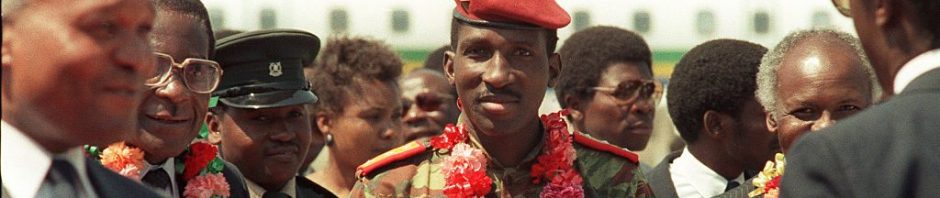
Please read Sankara’s two short speeches “Imperialism is the Arsonist of our Forests and Savannas” and “A United Front Against Debt (1987)” and watch the short film Thomas Sankara: The Upright Man (2006). You can find the live streaming link to the film, which is available through the ASU library, on the course website under topic “Week Eight.”
Post a short reflection on how the film and Sankara’s speeches may enable us to think about the following questions: What is the essence of neocolonialism, of decolonization, and of anti-imperialist struggle, in Sankara’s view? What can we learn from Sankara’s revolution in terms of building more sustainable, resilient and just societies in response to the current global crisis?
 SD 3800 Voices in Sustainable Development
In Sankara’s revolution, the fight wasn’t about capitalism vs communism like it was suggested by France and The U.S, it was a fight for who gets to stay in power. Market capitalism benefits those who stay in power and ensures those in power hold the opportunity for “exponential” growth. This growth needs countries like Burkina Faso solely as indebted, cheap labor. This is what Sankara set out to rectify. He saw Burkina Faso as the perfect place to begin reinvesting into the people at a local level. I believe this may have ultimately failed for a variety of reasons. For one, the country’s elite still wished to have ties to France and ultimately tried to undermine him for fear of loss of power. Second, I believe he may have not gone far enough into localization. He localized at a government level but not at a community level and the power was still in his hands even if he didn’t use it for his own personal gain. If he were to increase community in his new society he wanted there would be more people comfortable with staying there and not reverting. I liked how his development practices reminded me of both Fanon and Gandhi’s views of internalizing country operations and reinvesting in the people. It is this isolationism that typically proves to be fruitful for developing countries when looking back to history as well. We can learn from his revolution and those who came after him by understanding the importance of community action and the ability to own our own means of life than to be dependent on someone else whether it is a government at home or abroad.
-Tyler Nece
Thomas Sankara saw neocolonialism as the continued economic, political, and cultural domination of Africa by former colonial powers, sustained through resource extraction, and dependency on foreign aid. In 1987, he gave a speech “A United Front Against Debt,” where he declared that debt was a modern form of slavery, that was intended to keep African nations subjugated to Western Financial insitutions. He argued that repayment meant sacrificing essential services and sustainable Development.
Decolonization is not just about political independence but also about economic independence and reclaiming self-sufficiency. The film highlights his ideas of food sovereignty, industrial self-reliance, and land reform. He campaigned to “consume what we produce and produce what we consume.” Which challenges the neocolonial economy that kept African Countries as suppliers of raw materials.
Sankara’s speech “Imperialism is the Arsonist of Our Forests and Savannas,” highlights his belief that environmental justice is linked to the anti-imperialist struggle. Colonial legacies has had a devastating effect on Africa’s ecosystems through desertification, land degradation, and deforestation. He launched one of the first reforestation programs. He emphasized the importance of the younger generations having awareness about their environment.
Kendall Nerenberg
To Sankara, imperialism thrives in spaces where autonomy is stripped. His famous line about imperialism being visible on the plates of the people from Burkina Faso because of all the imported food, and how the will of the importers is therefore enforced on the consumer. This is just one example of the autonomy being stripped from the African by an outsider. He states that there is enough food grown within the country to feed everyone, but importers have imposed a dependency complex on the colonized that lasted after liberation. He works hard, as is shown in the film, on supporting a well rounded sense of individual and communal self for the Burkina Faso people. Programs like required sports, larger connections of rural spaces, supporting local consumption, standing for women’s rights, education reform and vaccination rollouts are strategies to restore the respect and humanism that was stripped from their identities for generations during colonialism. Sankara is secure in his belief in the people of his country and took rational steps to reinstall that pride in the rest of his countrymen. Building on a strong sense of self helped unite the resistance by allowing them freedom to think on their own will. He empowered the population to find their self worth and recognize the power that they have when they join together. He inspired a view of Burkina Faso that the colonizers didn’t want the citizens to realize. Building a movement off of this empowerment is what kept it so steady and how Sankara remained so respected.
Posey Lester-Niles
In Sankara’s vision of the revolution, he desired to end colonial taxation upon his people, and ban unions and opposition parties. Through his plans, he wanted to tie in an environmentally-friendly perspective that brought the planet’s wellbeing into account. In a world where the consequences of colonial exploitation often ignored the planet’s wellbeing, Sankara introduced policies that highlighted environmental preservation as a foundational principle of his revolution. Through initiatives like reforestation programs, soil conservation efforts, and promoting self-sufficiency in agriculture, Sankara’s revolution was as much about the future of the earth as it was about the liberation of his people. With the promotion of sustainability and self-sufficiency, he sought to promote independence.
After reading Imperialism is the arsonist of our forests and savannas, I saw that Sankara’s view towards the essence of neocolonialism was intertwined with themes of environmentalism. He stated “I come to you in the hope that you are taking up a battle from which we cannot be absent, we who are attacked daily and who are waiting for the miracle of greenery to rise up from the courage to say what must be said. I have come to join with you in deploring the harshness of nature. But I have also come to denounce the ones whose selfishness is the source of his fellow man’s misfortune. Colonial plunder has decimated our forests without the slightest thought of replenishing them for our tomorrow’s.” Sankara highlights how imperialist powers, motivated by greed and exploitation, have systematically ravaged the natural resources of Africa. The phrase “colonial plunder has decimated our forests without the slightest thought of replenishing them for our tomorrow’s” emphasizes the short-term, extractive mentality that dominated colonial rule, which left African landscapes depleted and vulnerable.
I think that through Sankara’s revolution, and his viewpoints on how we can live our lives, displays how we can be much more resilient and adaptive as independent entities and smaller communities. By rejecting foreign aid, which he saw as a form of neocolonial control, and instead promoting local entrepreneurship and innovation, Sankara demonstrated how smaller, independent communities could resist the pressures of global capitalism.
-Hadley Tavernier
In essence, Thomas Sankara saw neocolonialism, and subsequently decolonization and anti-imperialist struggle, as violent. Initial colonizers of Africa continued exerting economic and political domination over nations such as Burkina Faso under the covetous neocolonial agenda. In Sankara’s “A United Front Against Debt,” he pointed to debt being a modern form of slavery, of which the Western world would certainly always maintain domination over the Eastern world. Sankara completely embraced the inherently violent nature of anti-imperialist struggle, even after becoming aware of a plot for his assassination but holding true to his values until his murder was carried out. Before and after his passing, he empowered citizens of Burkina Faso, giving them the tools to fight off imperialism. He restored a sense of autonomy among the people through implementing means of consuming locally. People who do not depend on others for life sustaining goods may thrive autonomously, and people who pour their money into their own communities are active agents in anti-imperialism, as reflected in his “consume what we produce and produce what we consume” campaign. In the wake of crisis, Sankara counteracted the violent means of neocolonialism with community building programs such as mandated sporting events, of which even he participated in. He swiftly vaccinated his people, made women active agents in the economy, ridded of the superior status of government officials, connected people through railways and roads, reformed the education system, and reforested the land following the plunder of natural resources and landscapes, as he spoke about in his “Imperialism is the Arsonist of our Forests and Savannas.” All of these programs worked to instill a sense of worthiness, dignity, and self-respect among the people of Burkina Faso. A healthy body correlates with a healthy mind, and a healthy mind may guide itself with resiliency. As the film noted, Sankara was a man who very intently and necessarily was the epitome of the Western world’s ‘worst nightmare’.
-Carson Mease
Thomas Sankara’s vision of neocolonialism, decolonization, and anti-imperialist struggle was founded on a fundamental rejection of economic dependence and a dedication to self-reliance. In The Upright Man, we see how Sankara resisted foreign dominance not just through words but also through action. He did this by redistributing land, encouraging local industry, and opposing debt as an instrument of neocolonial oppression. His statement about imperialism as an ecological arsonist emphasizes how environmental degradation is directly connected to oppressive economic systems, foreshadowing today’s climate problem. Sankara’s movement provides important lessons for dealing with current global challenges. His emphasis on food sovereignty, grassroots democracy, and women’s emancipation as critical components of Burkina Faso’s development emphasizes the importance of comprehensive approaches to meet the goal of creating a sustainable and just society. His rejection of debt is especially relevant in an era when Global South countries continue to bear the brunt of financial and environmental responsibilities created by wealthier nations, usually that of the Global North. Sankara’s vision encourages us to reconsider development as self-determined freedom, an attitude needed for creating resilient and just communities in the face of persistent global injustices.
Margo Smith
Thomas Sankara’s view on neocolonialism is one which I believe to render as original colonizers continuation of power. It is thus, that Sankara hoped to rebuild Burkina-Faso in a completely alternate light. His system deployed the opposite motives to Western narratives and oftentimes uplifted those which were previously viewed as inferior. A prime example being women, his empowerment of women brought forth an approach previously ridiculed and went against neocolonialist regimes. Moreover, he supported the idea of locality explaining that self-sufficiency was possible if the idea that Burkina Faso and other African nations “owed” their goods to the West was abolished African nations would grow. This idea of self-sufficiency and locality is heavily critiqued by western neocolonialist nations as it defeats the current dominion and power held upon “developing” countries this stagnant notion allows for the continued growth of Western nations whereas the “developing” world remains in a stagnant state. Sankara’s ideas however allowed for these opinions to change and adapt to a new sense of growth that did not align with the “western” ideas. The Ideas of Sankara include the previously mentioned locality and involvement of women but also include the connection to his people by making government officials more equal to the general public and building railways for connection to the communities he also maintained in contact with the people of Burkina Faso consistently not creating a superior complex in any sense. Additionally, he pushed for reform of the educational system and moreover displayed a connection to the natural world through his attempts to limit desertification in this he reforested Burkina Faso and discussed the need for environmental protection through youth engagement. Therefore, I believe Sankara acts as a guiding light for many changes needed today that stress the importance of community and equality, listening to the people as opposed to the current American president who listens strictly to the 1% ignoring the needs of the people and the actions which are needed. Moreover, I believe Sankara speaks for the countries currently stuck in the loop of supply for the West mentality that self-sufficiency and internal growth is possible without the influence of western nations and “foreign aid” which in many instances only further inhibits the gap and power held upon developing nations.
Thomas Sankara saw neocolonialism as the continuation and valorization of colonial structures and practices which occurred during the colonial state. Sankara’s revolutionary decolonist vision is one of the mind, body, and soul. Public housing programs, ecological restoration, road and railroad building, and women’s rights advocacy were just a few of the programs and campaigns that Sankara implemented. The ultimate goal of these campaigns were to make Burkina Faso self-sufficient and completely separate from the economy and epistemology of the first world. He saw decolonization as a process of personal, economic, and political emancipation.
Much can be learned from Sankara’s revolution. The ability to recognize one’s self-worth and sovereignty, and subsequently mobilized an entire group of people to change their way of thinking and living is empowering. From Sankara’s perspective, a revolution in one’s thinking is one way to achieve a sustained and successful revolution in the political sphere. To get people to support your cause you have to get them to care first. Resiliency can only be achieved when a group of people truly believe in the change they want to see. Sankara smartly tied his ecological and economic campaigns to African customs and traditions. This made it easy and again, empowering, for his people to adopt a revolutionary spirit.
John Turner
Thomas Sankara’s legacy, as explored in the film Thomas Sankara: The Upright Man and in Thomas Sankara Speaks, offers a compelling critique of neocolonialism, decolonization, and anti-imperialist struggle. Sankara viewed neocolonialism as the ongoing dominance of former colonial powers through economic and political means, perpetuating Africa’s dependency on foreign aid. In Imperialism is the Arsonist of our Forests and Savannas, Sankara states that imperialism does just that, thereby showing how the exploitation of African resources leaves destruction in its wake. He argued that true decolonization was not just about gaining political independence, but largely rejecting the economic systems that continue to exploit and control. Sankara believed that Africa’s true freedom could only come when nations stopped relying on foreign aid and took charge of their own resources and futures. He did this by achieving a country-wide state of self sufficiency. He established a focus on local food and textile production, building infrastructure like roads and railways, and launching large-scale tree planting campaigns to combat deforestation.
Sankara’s revolution offers valuable lessons in building more sustainable and just societies. In A United Front Against Debt, he sharply criticizes the burden of debt, declaring, “We must refuse to be a slave to foreign debt. We must take control of our own resources.” This call for self-reliance was reflected in his policies in Burkina Faso, where he prioritized local production, education, and healthcare while fighting deforestation. His efforts, such as planting trees, providing education to all, and establishing gender equality, demonstrate that sustainable solutions must address both social and environmental issues. Sankara’s revolution teaches us that resilience and justice come from grassroots empowerment and collective responsibility. By rejecting external control and focusing on local, sustainable development, his vision provides a roadmap for confronting today’s global crises of inequality and environmental destruction.
Kendall Williamson
Thomas Sankara finds the essence of neocolonialism, decolonization, and anti-imperialist struggle to be intimately connected, with the understanding of these concepts being deeply important to the revolution in Burkina Faso – the way to find true independence. Sankara criticizes neocolonialism as a method of maintaining economic control over Africa and other post-colonial regions. He used the IMF and World Bank as examples of neocolonialist forces in his 1987 speech “A United Front Against Debt”. He states that “The debt is a new form of slavery,” used as a means of keeping foreign powers dominant in African regions. He also argues that to achieve true decolonization is to achieve true economic and cultural independence by breaking away from neocolonialist rule. In his speech “Imperialism is the Arsonist of our Forests and Savannas”, he promotes cultural decolonization and the rejection of western values and their false superiority as a means to celebrate true identity. Additionally, Sankara finds imperialism to be a significant international force, with the argument that several means, particularly political and military, were used as a way to maintain power over people and resources in the global south. He pushed for strong military defense over sovereignty, and called for resistance of foreign intervention with direct force if necessary.
There is much to learn from Sankara’s revolution in terms of sustainability, resiliency, and justice in our current societies – particularly in reference to current global crises. I found two examples to be particularly intriguing, one being his National Reforestation campaign. I appreciate how this movement promoted both resiliency and sustainability by responding to foreign exploitation of their land and natural resources. This movement also promoted community involvement and awareness of foreign practices, important social aspects of Sankara’s revolution. Another example of sustainability and resiliency is demonstrated in his restriction of timber exportation. These restrictions not only allowed tree populations and greater ecosystems a chance to recover, but also cut off the potential for foreign exploitation, and promoted economic independency and self sufficiency. Each of these practices could be appropriate implementations to exploited societies struggling with sustainability and resiliency, both from an environmental and social viewpoint.
Paige Kaine
Sankara found neocolonialism to be a continuation of colonial domination based on cultural and economic means. He fouond that even after achieving political independence from France, still, many African nations were subjugated by the foreign powers through cultural imperialism, debt, and unfair trading practices. In Sankara’s speeches, he would emphasize the need to move away from and reject foreign aid that came strings attached. He even vouched for the exploitation of his own resources to avoid depending on importations, “Sankara is convinced that the country’s own resources must be exploited as a priority to avoid depending on imports,” (The Upright Man, 16:41).
Sankara believed that decolonization was more than just gaining political independence. He thought it was more about achieving economic autonomy and cultural liberation. Sankara often advocated for the revival of the traditions, languages, and values of Africa. His policies focused on education, healthcare, housing, and land reform and had a goal of empowering the people to reduce independence on the western world.
The anti-imperialist struggle that Sankara had was deeply rooted in the belief that the only way true liberation could be achieved was through solidarity between all of the oppressed nations and people. Sankara wanted a united front against imperialism and encouraged African nations to support each other in their quest for economic and social justice. Sankara’s famous speech showcased imperialism in a way that it was revealed to everyone just how much they actually each depended on each other, “Just look on your plates: you see imported corn, rice, or millet, this is imperialism. Let’s not look any further,” (The Upright Man, 1:31).
Parker Williamson
Based on the speeches and the film by Sankara, the essence of struggles of neocolonialism, decolonization efforts, and anti-imperialism, is based on the power and authority of the West and the East. The lack of self-sufficiency in African countries contributes to this idea of constantly needing aid and a victim mentality. Which, proven by Sankara, is not true and does not need to be this way. Sankara states in the speech, “A United Front Against the Debt,” “Let us produce in Africa, transform in Africa, and consume in Africa. Let us not export what we produce raw. Our continent has enough resources to feed itself, and yet we import what we eat. This is not independence.”
By relying on imported goods as a way of life, it’s impossible to achieve self rule.
Breaking this system is a very essential goal of Sankara and making revolutionary structural changes.
Sankara advocates for holding these authorities accountable for their power imbalances and inequalities with the citizens, including not supporting the progress that has been made, due to the systemic conditions. In the speech, “Imperialism is the Arsonist of our Forests and Savannas, “We are not against progress, but we do not want progress that is anarchic and criminally neglects the rights of others.”
In terms of taking Sankara’s ideas and applying it to the present day, and working towards a sustainable future, considering the current global crisis, I really am touched by the part of the movie showing the young individuals being trained in the pioneer movement, to perpetuate and advocate for his revolutionary ideas. Imprinting the young people of this generation with these ideologies of working for structural change, advocacy for women in society, and a self-ruling society. It gets the young children involved and aware of the structural imbalances and inspires them to fight for change and show the effectiveness of community effort.
Abbey Smith
In his speeches, Sankofa views neocolonialism, decolonization and the anti-imperialist struggle to be all connected. He believed that relying on the struggles of revolution leads to experiencing the abundance of joy and happiness can take place. Sankofa also says how managing funds better would better increase the resources for modern investments. After reading his speeches, I also feel like Sankofa believes that getting rid of a certain kind of mentality (the welfare mentality) due to the effects of being colonized and having a relationship with France and the expectations of this certain relationship. Part of Sankofa’s beliefs on these three things is you can’t carry out any kind of fundamental change without there being chaos and hardship.
Things that we could learn from Sankofa’s revolution is development requires you to solve different problems. Also, hunger is a cynical problem in Burkina for years, and this is due to the lack of organization and the little attention that is paid to rural areas. This is also due to a lack of production that is also inadequate. He believed that relying on the struggles of revolution leads to experiencing the abundance of joy and happiness can take place. Part of Sankofa’s beliefs on these three things is you can’t carry out any kind of fundamental change without there being chaos and hardship. He believed that from an imperialism point of view, it’s important to dominate culturally in the military because cultural domination is more flexible, more effective and less costly. The reason why he believes that it is so important to fight for imperialism is in case of a bigger power withdraws its aid and it causes even bigger problems.
Ciara Gurganus
In Thomas Sankara’s view, neocolonialism, decolonization, and anti-imperialist struggles are the difficulties that come with a country trying to seek true independence. Despite going through a period of decolonization, Burkina Faso was still dealing with the consequences of colonists actions from previous exploitation. This is what Sankara points out in the speech “A united front against the debt.” Their country still faced a debt that Sankara decided they would not pay. They could not pay because it was a debt that was placed on them through deceitfulness and they were already owed a debt of blood. Despite being decolonized, they were still in slavery due to this debt and it contributed to the lack of wealth flowing into their own communities. This is why Sankara suggests the true freedom of his people via changing the system. When on the topic of the economy, Sankara suggests that citizens buy clothes and food that were produced locally, so that they do not give in to the dependence on foreign countries. In the chapter on the emancipation of women, Sankara explains how the equality of women is important in creating a society that is free of slavery and exploitation. This is an especially unique ideal of the time as it considers a demographic that is often overlooked or misrepresented.
By taking the actions of Sankara that I have described, we can come to a more just society that is free of inequality. This also created a resilient nature for the Burkina Faso people, in the movie it is shown how united the people became from this social reform. Young people came together to plant trees and enable conservation, which is just one way Sankara’s ideas promote sustainability. More individuals were given the opportunity for an education. Overall, the dependence on only one’s own nation is very important for creating a sustainable, resilient, and just society. Whether that be anti-imperialism or something else, we can look to Sankara for inspiration in building group morale, creating social reform and accountability, as well as promoting ideals that bring about equality for all.
Ella Holmes
Sankara is very direct and straightforward about what neocolonialism looks like in his country. He identifies banks and other international financial institutions as creating one-sided and unfair contracts that lead to the exploitation of his people and to the failure of their endeavors. He also identifies an example of this as natural resources and nature in general, as a place of exploitation and as a starting point for decolonization. He emphasizes the protection of natural resources (especially in his “arsonist” speech) as a political struggle, as opposed to a community or societal struggle as it requires funds that are wrapped up in colonial oil efforts and the like.
In order to win the fight against imperialism and neocolonialism, he argues for complete African independence. Free from unfairly wagered imperialist debt from institutions like the IMF, unfairly created contracts dictating African imports/exports that leave African nations with nothing, and fostering local economies as opposed to relying on foreign ones.
In essence, he argues for local production and consumption, new and sustainable farming practices, a complete reform of African education and inclusivity norms, and overall community involvement in new initiatives that build economic resilience and create equity across the board.
-Jack Brion
As an audience, we can make conclusions about Sankara’s views on neocolonialism, decolonization, and of anti-imperialism based on the film Thomas Sankara: The Upright Man and the selected readings from Thomas Sankara Speaks. His famous call and response speeches, which are showcased throughout the film and text, embodies his approach. When Sankara yells, “Imperialism!” the crown replies, “Down with it!” and so forth with other similar sentiments. This direct involvement of those he is speaking to is mirrored in his governmental initiatives that uplift the Burkina Faso people and put them in charge of their quality of life. One specific example of this is his advocacy for women’s rights. Sankara explains, “This means that we must give a job to every woman in this country! We must give every woman the means to earn an honest and decent living!” (9:01). He empowers men and women to shift away from patriarchal tradition by encouraging men to shop for household groceries and opening military service opportunities to women. With initiatives such as these, it is clear that Sankara believes decolonization and the anti-imperialist struggle is fought by empowering and educating the Burkina Faso people. This is also reflected in his initiatives to dismantle elitist government culture, remove colonial taxes, reduce the traditional power of chiefs, improve national infrastructure with railroads, etc. When applying Sankara’s revolutionary philosophies to building more sustainable, resilient, and just societies I feel an excerpt from the chapter Dare to Invent the Future is deeply relevant. When asked by Swiss journalist Jean-Philippe Rapp what image Sankara would like to leave of himself and his role, Sankara replies thoughtfully, “I would simply hope that my contributions had served to convince the most disbelieving that there exists a force, called the people, and that we must fight for and with the people… I would like this same conviction to take hold of others so that what seems to them today to be a sacrifice will seem tomorrow to be normal and simple activities… Perhaps we’re blazing the trail along which, tomorrow, others will surge forward cheerfully” (Sankara, 240). This quote speaks to the cultural shifts integral to creating a more sustainable world, where the exploitation of humanity and the environment are not normal.
Clara NeSmith
Thomas Sankara was an exceptional leader advocating for self-sufficiency and independence for Burkina Faso (the Land of Upright People). He continuously pushed to end neocolonialism and emphasized the need to “consume only what [Burkina Faso can] control”. Thomas sought to transition the young state into a locally driven and self-reliant powerhouse, developing and manufacturing in-state commodities such as agricultural and textile products for the benefit of a newly developing state. Another eye-catching concern for Sankara was the environment, where he took several initiatives fighting desertification. Another self-sustaining socioeconomic and environmental initiative combating desertification relates to one village, one grove. This is where young and old people conduct agricultural operations within their village, such as reforestation and crop production, to expand their sufficiency and independence. Overall, Sankara rejected French imperialism and promoted an array of economic, political, social, and environmental transformations across the country to create an independent self-sustaining state.
To conclude, Sankara would be considered a radical left-wing protagonist. His revolutionary policies prioritized self-sufficiency and grassroots development, while opposing French imperialism through diplomatic relations. Sankara was an inspiring selfless man who opposed self-portraits and greatly cared for the nation’s prosperity. However, according to the people Revolutionary Tribunals, Sankara did not respect individual rights. Like any civilization, conflict occurred and a lawyer could not represent you. Teachers went on strike only to be repressed and dismissed. The teachers were then replaced by revolutionary teachers learning a quick ten-day ideology to lecture to children. Sankara’s governing structure was that “[if you went on strike, you are against the revolution]”. In the end, Sankara’s circle crumbled within and loyalists switched sides. A surprise attack at the presidential palace led to his demise.
Thomas Sankara rejected the notion that African countries should remain economically dependent on their former colonizers. He recognized that Burkina Faso’s ties with countries such as France were harmful, viewing loans and foreign aid as tools of oppression that ensnared African economies in cycles of debt long after independence had been achieved. Sankara emphasized the pressing need for the decolonization of African minds. He urged Africans to dismiss European standards of wealth and pushed for a return to indigenous traditions, advocating for genuine self-determination and autonomy. By promoting the local production of food and goods, he asserted, “It is natural that he who feeds you also imposes his will. He who does not feed you can demand nothing of you.” When a country relies on others for basic necessities, it loses its sovereignty because those providing aid or resources will always dictate terms and conditions. Sankara was also a passionate advocate for environmental conservation, blaming imperialism and capitalism for ecological destruction in Africa.
Considering Sankara’s inspiring legacy, we can still learn from his leadership today. With many regions of the world still facing issues of neocolonialism, promoting self-sufficiency over economic growth will improve local resilience, reduce dependency on foreign aid, and empower communities to take control of their resources.
-Amelia Hagen
Thomas Sankara viewed neocolonialism as a contemporary form of colonialism. Although Burkina Faso was politically independent, Burkina Faso and many other African states were reliant on the colonial powers and capitalist systems. This created a relationship of dependency which Sankara aimed to avoid. Although Burkina Faso was independent, colonial powers continued to extract resources, depleting their living conditions and contributing to environmental hazards such as desertification.
In Sankara’s quest for decolonization, he sought to gain liberation economically and socially. Illustrated in the film, Sankara encouraged reclaiming cultural heritage and the identity of African people by emphasizing that one should live the “African way.” He saw no need to develop like the west, nor serve the interests of colonial powers. The colonial powers were continuing to exploit Burkina Faso, which had devastating effects on the environment, culture, and politics.
Sankara also argued that imperialism was one of the root causes of economic and social problems within Burkina Faso. To fight the system, he wanted the wealth from resource extraction in Burkina Faso to benefit the people living there. Sankara also encouraged Africans to embrace cultural traditions by wearing locally made garments and eating locally grown food. In a speech made in the film, he asked the audience where it was apparent that imperialism had taken hold of Burkina Faso and told them to look at the plates of the food they ate, noticing that they were all imported goods. Sankara wanted a self-reliant Africa, the restoration of cultural identity, and liberation from foreign dominance.
Sankara’s revolution makes it apparent that cultural identity and social liberation can change societal structures. His quest for sustainability and a self-reliant Africa is extremely relevant in global contexts. Local production of goods will aim to benefit the local economy, the populations in those areas, redistribute wealth, and restore environmental concerns. Sankara’s ideas on consumerism, environmental sustainability, and the reliance of foreign aid are all beneficial responses to the current global crises.
-Ava Allen
In Thomas Sankara’s view, neocolonialism is about the lasting impact of previous colonial powers on former colonies, especially from the taking of resources and in monetary ways. In his speech, Imperialism is the Arsonist of our Forests and Savannas, Sankara says, “Colonial plunder has decimated our forests without the slightest thought of replenishing them for our tomorrow’s.” In this speech, he also says, “It is these prohibitive conditions that lead to our country’s traumatizing debt and eliminate any meaningful maneuvering room.” This leads into his speech, A United Front Against Debt, where Sankara says, “Under its current form, controlled and dominated by imperialism, debt is a skillfully managed reconquest of Africa, intended to subjugate its growth and development through foreign rules. Thus, each one of us becomes the financial slave, which is to say a true slave, of those who had been treacherous enough to put money in our countries with obligations for us to repay.” This ties into the anti-imperialist struggle. There is no true decolonization if there is only the absence of a colonial ruler, but not the loss of debt to colonial powers and powerful financial institutions. Sankara believes in breaking the dependency on external sources and becoming economically self-sufficient.
A big thing I took away from Sankara’s views for building a more sustainable, resilient, and just society is the idea of locality. A quote from his speech, A United Front Against Debt, “Let’s also make the African market be the market for Africans: produce in Africa, transform in Africa, consume in Africa. Let’s produce what we need and let’s consume what we produce instead of importing.” I also really think Sankara’s ideas of gender equality are very important for making a just society. There’s a line from the documentary which says, “He creates a real shock by being one of the first heads of state in the world to promote women’s rights.” There are a lot of things we could learn from Sankara’s ways for approaching our future.
The film showed that Sankara had a vision and a code of living that he lived by until the day he died. The efforts he made to have people be equal no matter how high of political office they hold. People all drove the same cars and were of common ground compared to a colonialist power scale. Sankara lived a very simple possession life that can be very sustainable compared to the lives in the Western world influenced by capitalism and consumerism. People live with an abundant amount of things that serve no true purpose in their homes. In places that require a higher priority on certain resources, you want to live with less to conserve for the people. Trying to fight a well-established system will always be an uphill battle and needs all the support that the case can receive. The vaccination day helped thousands of people and that put faith that there is someone from the country that can support the people. A powerhouse monster such as France will try to exploit as much as they possibly can and it was only a matter of time until people had had enough. Localized change is how the colonial system will get pushed out and even if there is a figurehead leader they have to be strong and show people that the right thing is to follow them. After the term or life of that person, it should have a lasting impact to help the country improve upon itself rather than unwinding what progress has been made.
-Vincent Spinelli
In Sankara’s view, neocolonialism is inherently violent to grasp the power of people, culture, and narratives; therefore there is no choice but to resist through decolonization and take all of this back. He took back power in a multitude of ways, one of which recognized the metropolis-satellite relationship of the North and South, specifically Burkina Faso with Northern powers like the French. This was a main point of discussion in A United Front Against Debt where Sankara states that “debt’s origins come from colonialism origins.” Sankara indicates that colonialism is truly the antagonist; thus, Burkina Faso and, by extension, Africa cannot and should not pay for the debt. Therefore, part of his anti-imperialist focus was resisting dominance and oppression from other countries, especially Northern powers.
We can learn various methods from Sankara’s revolution such as prioritizing people over capital and knowing that decolonization comes in many forms. One major thing to learn is that people and nature are the priority; this reminds me of Gandhi, Thoreau, and Fanon’s point in reinvesting in the self and the world around you rather than capital and power. Sankara pursued reinvesting in his community of Burkina Faso which fed into other countries; I think that’s why he’s still known as such an impressive and admirable figure in Africa today. He prioritized autonomy and agency of those in his country, this was shown by his support of women’s rights, commitments to healthcare, reforestation, etc. to promote resiliency and people’s care for their own country.
-Iona Blackburn
Some of the things people think about when they hear the word revolution are bombs, guns, civil unrest, and dis-organization. Thomas Sankara’s vision of the revolution was different than that, as he sought to create a national identity forged in principles of resisting neo-colonial forces and self sovereignty through restoring autonomy for the people of the nation. He was starkly against gender and class divisions that kept people from uniting against a common cause. Through his speeches, he acknowledged there is a shared mindset among many people that a few people acquiring large sums of money is what’s keeping people in slums and ghettos. Sankara sought to transform national consciousness through rhetoric and the idea of material self dependence, as he heavily stressed the need for less imported goods. He transformed the mindsets of people in and out of Burkina Faso and supplied them with spiritual and material means to fight off imperial forces. Through mass vaccinations, lowering the salary of public officials, urging the importance of women in economic fields, and combating growing desertification, he showed the rest of the world that self-sufficiency and economic growth and stability are not mutually exclusive phenomenons. I believe one of the biggest things to learn from Thomas Sankara is to be an advocate for unity, to try and bring people together under a greater cause in this current climate of division. Feeling a collective push for sustainability and social justice issues will mobilize people into action. Sankara also had incredible leadership skills and made it his mission to fish out corruption in his nation. Today, we rarely see leaders that are willing to stand on their values and sacrifice their comfortability. Sankara established a new status quo for himself and fought relentlessly against conforming to neo-colonialist ideals, which is a strong conviction we could use in today’s climate. – Peyton Berger
Thomas Sankara and the revolution he spearheaded in Burkina Faso provide an illustration of the ideas and practices associated with decolonization and anti-imperialist struggle in the face of neocolonialism. Sankara viewed the revolution as a way to empower Burkina Faso by eliminating the reliance on western money, power, and products. He viewed this reliance as artificially constructed in order to maintain dominating political and economic structures, dooming Burkina Faso and many other African countries to suffer ecological and societal destruction. This phenomena is at the heart of neocolonialism, where more indirect and often discreet influence is exercised over formerly colonized countries through economic and political sabotage. A country that relies so heavily on other, more wealthier countries for food is essentially powerless, and can be exploited to no end when furthering western interests.
In Sankara’s eyes, a key part of revolting against this oppressive system was to maximise Burkina Faso’s self-sufficiency through the domestic production of food, clothing, and infrastructure. Sanakra also implemented cultural and social ways of promoting domestic consumption, particularly clothing, where he would playfully call out citizens wearing brands like Levi’s.
Beyond the more traditional modes of production, Sankara highlighted the importance of ecological health, which is often in opposition to imperial forces. A central point of the Burkina Faso revolution is its focus on the rehabilitation of natural systems around the country, and to prevent further encroachment of the Sahel desert and its inhibitive effects on the Burkinabé. Much of the harm suffered by the Burkinabé and their natural environment stems from the imperial nature of neocolonialism, which Sankara describes in a 1986 as “The unpunished disruption of the biosphere by savage and murderous forays on the land and in the air..”. In the same speech, Sankara describes the many steps taken as part of the revolution in order to prioritize ecological health from both a governmental and societal perspective. These included governmental programs for conservation and reforestation as well as social initiatives that promoted tree plantings at community events like weddings. Sankara’s environmental efforts seem to contribute to a broader goal, “We therefore wish to affirm that the battle against the encroachment of the desert is a battle to establish a balance between man, nature, and society”.
The story of Sankara and the revolution in Burkina Faso provides a blueprint that, while flawed, outlines effective steps in creating a more sustainable and equitable society, even in the face of oppression. Sankara’s prioritization of community engagement, self-sufficiency, wealth redistribution, and environmental enrichment proved to be effective in Burkina Faso, and could undoubtedly become the cornerstones of future movements toward a sustainable society. Another big reason for the potential success of Sankara’s ideas are their focus on catering to the common citizens’ needs while remaining relatable. Sankara’s ability to converse freely with people and speak in formal/settings settings in an authentic way was a key point of success for the movement, and Sankara’s continued praise long after his passing. The longevity of his legacy has also been in part due to his focus on equality for all members of society, and the practical ways he achieved such goals. I found the women’s day community activity of having the men go to market to purchase groceries a particularly effective and endearing way to challenge existing gender roles and open the door for more progressive dynamics in Burkina Faso. THe revolution in Burkina Faso provides various methods of pursuing sustainability and anti-colonialism in society both theoretically and practically, while also showing opportunities for improvement in terms of the more stringent aspects of Sankara’s government.
-Max Lawrence
In the speeches from Sankara, “Imperialism is the Arsonist of our Forests and Savannas” and “A United Front Against Debt” along with the short film The Upright Man, it is quite evident that Sankara is not a huge fan of neocolonialism. In “A United Front Against Debt”, Sankara makes the statement of “Debt is a cleverly managed reconquest of Africa” which I at least interpreted as loans from what are considered Western countries are essentially preventing any sort of development due to this endless cycle of needing to repay these debts. As such, Sankara proposes that instead of continuing to cave to Western pressures, African leaders should instead be investing in local economies and communities in order to be a self-sovereign society or in other words self-sufficient which coincides with Sankara’s belief that in order to truly decolonize you need to not only gain independence but also rely less heavily on foreign goods but instead push for production of products by these communities which honestly I feel both of these lessons are quite relevant with how capitalism at least in the US currently is feeling with Trump’s tariffs and the current state of the economy not looking particularly great.
– Connor Kuharcik
Based on the speeches I have seen and read from him, as well as the documentary, I believe Sankara falls somewhere between Fanon and Gandhi in terms of neocolonialism, decolonization, and the anti-imperialist struggle. He wanted to show Burkina Faso’s strength and nationalism through his military uniforms and garb he required public officials to wear. I’m confident in saying that he was against the neocolonialist chokehold that France had on Burkina Faso. Sankara’s methods of holding his people accountable are something I greatly admire. He truly worked for his people and made sure the officials around him did the same by revoking the fancy cars, first-class plane tickets, and houses. Fanon says it best “The enemy now modifies its tactics… As we have seen the peasant masses, steeped in a never-changing routine, continue to revere their religious leaders… Colonialism secures the services of these loyal servants by paying them a small fortune.” I could not find the exact quote, but I believe Gandhi also addressed this by stating that if you truly care about the public good, you should be willing to work for free. I bring this up because neocolonialism allows one country to indirectly control another, and three important leaders were aware of this. Neocolonization exploits those that the nation values most in order to maintain power.
Sankara believed that a healthy environment resulted in healthier people. He believed in community and accountability, and he encouraged people to be mindful and conscious of their environmental impact. In response to the first question, he believed that fighting to protect the environment was a fight against imperialism in Burkina Faso. He advocates for colonial dependency to be eliminated by encouraging Africans to work together to rebuild their natural resources.
Aura Cochran
The essence of neocolonialism, of decolonization, and of anti-imperialist struggle, in Sankara’s view is that he wants his country to be self-sufficient and to not rely on assistance from international aid. It is very interesting that he was able to take his country out of misery. However, when the French heard this, they wanted to keep control over their former colonies and avoid the Sankara view from spreading. He was later killed for his ideas that even the people he trusted with his own country betrayed him. The North and South benefiting from the underdevelopment in Africa. Even after Volta achieved independence in 1960 the country still has not evolved at all due to corrupt leaders this also goes to show that neocolonialism is deeply embedded in the system. He was one of the first to support women’s rights; he wanted unity and strength in numbers for change. To me he seems to have the views of Gandhi and Fanon combined. I have no doubt that he would fight for his country but in the video the resistance from neocolonialism is mostly peaceful, more like an encouragement. How we learn from Sankara’s revolution in terms of building more sustainable societies, is in the beginning of the video Sankara noted that their population produced enough food, actually more food that is needed and they still need aid in resources. In 1983 he was brought to power by one of the poorest groups on earth. He gave his country a new name Burkina Faso which means the land of upright men! He wanted his country to be so prosperous so that the west and east would not be needed. and Africa can rely on Africa.
Kye Harris
In the speeches “Imperialism is the Arsonist of our Forests and Savannas”, “A United Front Against Debt (1987)” and the film “Thomas Sankara: The Upright Man”, Thomas Sankara lays palpable explanations on his philosophy of the essence of neocolonialism, decolonization, and anti-imperialist struggles in Burkina Faso as a representative case and calls to action for continental transformation. Within Burkina Faso, Sankara describes the sustainable revolution against neocolonialism as complete separation from lingering colonial economic power structures and environmental control. Neocolonialism stems from later exploitation after the supposed end of colonial rule. Financial systems, resources, and environments are still controlled and maintained by the same colonial rule and psyche. To revolt, Thomas Sankara independently boosts health, education, food sovereignty, sanitation, equality, and transportation without foreign aid. Rejecting foreign aid removed Western exploitation of Burkina Faso’s natural resources for capitalistic gain, while proving to the African continent that a refusal of foreign aid can promote self-sufficiency and autonomy. Dismantling imperialist structures within Burkina Faso restores the country’s control over its resources, infrastructures, and political systems.
Decolonization to Sankra, is intertwined with the dismissal of neocolonialism and dismantling imperialism through the rejection of systems like the IMF and World Bank that trap countries into unbreakable cycles of debt. These initiatives proved that African nations could develop and thrive independently, which Western power has failed to recognize as possible or allow to happen at all, challenging the idea that foreign aid is essential for progress and rejecting modern-day imperialism. This paved the way for independent development for the people of Burkina Faso without relying on the economic dependency of foreign powers. An example of this is getting rid of feudal practices within schools, promoting women’s rights, encouraging young people to engage in reforestation, requiring traditional garb for public servants, and connecting rural communities.
What struck me the most was Sankra’s emphasis on the intrinsic ties between colonial rule and environmental health. He pushed to the people in his speech “Imperialism is the Arsonist of our Forests and Savannas” that the exploitation of Africa’s natural resources by colonial powers is tied to ecological damage which continues to keep Burkina Faso indebted. The degradation of land is interconnected to social and economic welfare. The Global capitalist system that is driven by imperialism and maintained by neo colonial exploitation exacerbates environmental destruction and socioeconomic inequality. Giving the power to the people to restore their natural landscape creates agency and power within each community. Restoring the environment is revolutionary in itself a way to reclaim land and resources from those who had historically exploited them.
Sasha Fuellhart
The documentary Thomas Sankara: The Upright Man tells the tale of a noble and resilient leader, remembered for his relentless fight against oppression, injustice, imperialism, and neocolonialism. The essence of neocolonialism, decolonization, and anti-imperialism are all deeply connected, and Sankara continuously pointed this out and led the fight against colonialism. Sankara saw neocolonialism as a new way for historically colonizing nations to continue imperialist control, and he led a revolution deeply focused on decolonization and anti-imperialism. These beliefs he held were rooted in promoting self sufficiency and local connectivity within his country. He wanted to move away from the western influence and he did so by promoting locally made ethnic clothing, planting trees, upholding women’s rights, and taking measures to be self-reliant as a nation. In minute 6 of the documentary you can see him chanting “down with them!” over and over again regarding the colonizers, imperialists, anti-revolutionaries, etc… and I find his presence when speaking to be very unifying. This is an important message that we need to remember now to be in alignment with decolonization efforts. Women’s rights and empowerment were also a huge part of his platform, celebrating international women’s day across his country, allowing for women to be empowered, and men to see what it’s like to do the jobs of a woman so they can understand their struggles and livelihoods.
In his 1986 speech Imperialism is the Arsonist of our Forests and Savannas, Sankara says, “My intention is not to heap unrestrained and inordinate praise on the modest revolutionary experience of my people with regard to the defense of the Trees and Forests. My intention is to speak as explicitly as possible about the profound changes occurring in the relationship between men and trees in Burkina Faso. My intention is to bear witness as accurately as possible to the birth and development of a deep and sincere love between Burkinabè men and trees in my Homeland.” In this, he explains how he wants to strengthen the relationship between man and his environment, a view that fundamentally challenges the imperialist relationship with nature. Learning from Sankara’s rebellious views can help us understand how to decolonize our minds and our surroundings. His views are in alignment with agroecology, sustainable land use, and localizing food production, all of which are important to the discussion of modern day sustainability and decolonization efforts. Sankara always made sure to always prioritize his nation above all else. In minute 20 of the film, he says “we must accept to live the African way, it’s the only way to live with freedom and with dignity,” and I think that statement is so powerful, and something that we should all take note of. His mindset and powerful positive influence helped shape revolutionary efforts around the world, and I am grateful for his beautiful perspectives.
Caroline Laschinger
In his speeches, Thomas Sankara addressed neocolonialism as an economic and political control disguised as independence. In the first speech, “Imperialism is the Arsonist of our Forests and Savannas,” Sankara condemns the imperial exploitation of Africa’s natural resources, correlating environmental destruction to global capitalism. In the second speech, “A United Front Against Debt” (1987), he argues that Africa’s debt was a weapon to further control the African nations, and Sankara encouraged resistance towards the repayment of the debt. Decolonization also meant more than gaining political freedom; reaching complete decolonization required economic self-sufficiency, food sovereignty, and the rejection of foreign exploitation. Sankara’s government promoted more local industries, reforestation, and encouraged women’s involvement, directly opposing the imperialist and current oppressive government structures. The assignation of Thomas Sankara in 1987, only a few months after his “A United Front Against Debt” speech, highlights how his vision threatened the preestablished global powers. His push for more self-reliance is becoming more relevant as nations continue to face economic instability and worsening climate change. His influential environmental policies, most notably his push for the mass reforestation of the region, became a model for future sustainable development and implementation and continue to inspire people to this day. Additionally, his commitment to women’s rights reminds us that justice can be completely inclusive. In a world that was still being affected by neocolonial forces, his message of resistance and sustainability urged people then and now to rethink development, resist dependency, and build independent, resilient societies.
-Fia Mascari
Thomas Sankara was steadfast in pointing out that Burkina Faso’s underdevelopment was not accidental, nor did it occur overnight. His revolution inherited the cumulative effects of centuries of colonialism and neocolonialism that saw Burkina Faso in a state of national destitution. This condition permeated all facets of life, which is something he expressed in his speech about desertification and the importance of restoring a balance between individuals, society, and nature that colonialism had historically undermined. As Sankara stated, the revolution is as much a revolution of consciousness as it is of the political and economic order; the latter can not succeed without the first. Consequently, he made an effort not only to raise the consciousness of the people through political education, but also by entrusting them with the responsibility of taking part in making the revolution themselves. This culture of accountability, from the peasants to his own administration officials, points to Sankara’s commitment to moral integrity, ideological consistency, and empowerment. These qualities have to be embodied, not merely spoken about, and his revolution exemplifies how that can be done in the real world.
Edit: *democratic empowerment*
-Jack Ely
*democratic empowerment
-Jack Ely
It won’t let me reply, but the last post is by Jack Ely.
Sankara views neocolonialism as a continuation of colonial exploitation through economic means, primarily debt. In “A United Front Against Debt,” he criticizes the portrayal of colonial influencers as “technical assistants,” claiming they are actually undertaking a “skillfully managed reconquest of Africa” by using debt as a form of control and subjugation of African development. For Sankara, decolonization requires rejecting debt payment and promoting self-reliance across Africa to collectively challenge the neocolonial system. He argues that African countries are not responsible for debts to countries that “suck our people’s blood and live on our people’s sweat.” He promotes the production and consumption of African goods to limit reliance on external aid and imports by supporting internal markets. Economic independence and African solidarity are also key parts of Sankara’s anti-imperialist struggle. Additionally, Sankara fights for popular empowerment through military training and revolutionary education for the masses, and their inclusion in decision-making and resource management.
Some valuable lessons from Sankara’s revolution we can adopt to address current global crises include reducing external dependence by fostering local production and consumption, empowering the masses through grassroots initiatives and participatory governance, promoting women’s rights, providing basic needs (healthcare, education, clean water), combatting governmental corruption, and promoting environmental stewardship.
Aaron Batty
Thomas Sankara surely goes down as one of the most respectable, revolutionary, and selfless rulers in global history. His ideals of African autonomy and desire to break away from dependence on colonialist powers, namely France, were truly novel at the time of his ruling. While Africa’s “dependence” on France had certainly been recognized by its citizens, the power structure was built in such a way that prevented any real change at the policymaking level. Sankara was the first to bring these ideas about in the governmental sphere and actually attempt to reverse the effects that colonialism had imposed on much of Western Africa. There is a quote towards the beginning of the film from one of Sankara’s speeches that reads, “This type of assistance is counterproductive and has kept us thinking that we can only be beggars who need aid.” This is a common theme in sustainable development and starkly illustrates how “third world” countries have not wound up behind the curve due to their own shortcomings, but rather it is a direct result of constructs put in place by colonialism. It also creates and reinforces a mindset of the citizens of these countries that they are helpless and their only hope for being saved is via the assistance of more developed colonial countries.
Sankara was the first African ruler to implement real policies in attempt to dig Africa out of the hole that colonial powers had put them in. One of his policies that I particularly appreciated was the mandate to only buy and use locally produced products. This would take away leverage from the French government in the sense that the people of Burkina Faso would no longer have to rely on Western-produced goods and could begin to bolster their own economy. As one of Sankara’s quotes aptly put it, “The one who feeds you will impose his will upon you.” Another one of his policies was taking away unnecessary luxuries of government ministers, such as expensive cars and garments. This was intended to change the social mindset in Burkina Faso and make its citizens feel less separated from those who oversee the country’s operations. He also was one of the first world rulers to push for women’s euqality, which absolutely sets him apart from his field at the time. All of Sankara’s ideas were carried out with the right intentions of creating a completely autonomous nation free of inequality, struggle, and most of all colonialism. Unfortunately, the French and Ivorian governments could not allow this to happen, and Sankara’s ideals were ultimately his demise.
Thomas Sankara does not hold back when speaking of revolution and describing the neocolonial forces that have spiraled his people into a cycle of dependency. Sankara points out the exploitation of his people through unjust contracts from multinational institutions such as the World Bank, that have resulted in debt build up. In the film Sankara makes it known, on camera, that his nation would not be paying the debt, not due to any other reason than the injustice that was facilitated by those contracts have rendered his people unable to pay them. Sankara goes on to request the support of his neighboring nations, half-joking that he would be assassinated if his cause went unsupported, showing his dedication in a light hearted way.
Sankara also talked about neocolonialism being rooted in the land and the surplus of natural resources that Africa has to offer in the film. Sankara was passionate about the idea of self dependency in Burkina Faso and wanted all the food being produced within the nation to feed its people. He states that even after liberation Burkina Faso remains in a dependency cycle that has been imposed on them by their colonizers and without breaking this cycle Africa could not acheive autonomy. Under a localized production framework Burkina Faso could escape its cycle of dependency and regain its autonomy culturally, financially, and particularly nutritionally.
Thomas Sankara looked at his people and saw their need and pushed for their needs to be met as adequately and as quickly as possible. Eventually, this model came to work against Sankara as well as for him when rapid change, disorganization, harsh enforcement of regulations, and unaccounted for abuses of power gave people reason to doubt the revolution and side with the group in Burkina Fasa that pandered to French interests. According to the film, this is one of the main reasons for his assisination. This scene also shows Sankara’s virtue when talking to his friend who recalled Sankara knowing that he would be assassinated but refusing to act first because it was up to the opposition (his friend) to betray their trust.
Landon Dancy
In this film what I gathered was that Thomas Sankara rejected economic dependence on former colonizers and recognized that having ties with countries such as France that come with loans and aid, keep African nations in an endless cycle of debt. Sankara had a view of foreign aid as more of a tool of oppression that continuously undermines African sovereignty. He advocated for the decolonization in Africa, pushing to break away from European ideals of wealth and attempted to return to more indigenous traditions. Within this Sankara believed that true determination was possible through economic independence, he states “He who feeds you also imposes his will”. By advocating for local food and good productions, Sankara urged the need to abandon foreign resources as they erode the sovereignty, they have due to terms and services.
Sankara also was a strong advocate for the environment, putting blame on imperialism and capitalism for the stark ecological degradation that has occurred. He knew that the mass exploitation of their resources through external powers was harming both the African people and their land.
Now through Sankara’s legacy he offers us valuable lessons, living in a world that still encounters neocolonialism, emphasizing self-sufficiency and sustainable progress over simple economic growth can lead to a massive decrease on reliance on foreign aid, which in turn can enhance local resilience and allow for communities to flourish and grow as well as setting the land back and make it more sustainable.
-Lex Blake
Thomas Sankara’s speeches and the film Thomas Sankara: The Upright Man show his thoughts on neocolonialism, decolonization, and anti-imperialist struggle. Sankara saw neocolonialism as the ongoing exploitation of African countries by foreign powers even after they gained political independence. In his speech Imperialism is the Arsonist of Our Forests and Savannas, he explains how imperialism is not only taking Africa’s resources but also destroying its environment, leaving people in poverty. He believed that neocolonialism kept African nations dependent on the West through things like debt and foreign aid, which made poverty worse.
For Sankara, decolonization was about more than just political freedom. It was about building self-reliance and dignity while rejecting all forms of outside control. In his speech A United Front Against Debt, he calls on African nations to come together and demand that their debts be forgiven, seeing debt as another way to control them. His revolution in Burkina Faso aimed to create a fair society based on self-sufficiency, equality, and justice, focusing on things like education, healthcare, land reform, and women’s rights.
What we can learn from Sankara is that to respond to today’s global challenges, we must challenge the systems of control, whether they are economic, environmental, or political. Sankara showed that true freedom is not just about independence from colonial powers but about creating a world where people take charge of their own futures and resources, working together to build a more just and sustainable society.
-Will Bradford
The film shows Sankara as a visionary in the way that he works to build a resilient society focused on supporting women and improving self-sufficiency while rejecting foreign aid. He was far ahead of his time as he recognized the problems in our systems that we face now when they were still an early issue. He saw how neo-colonialism was a system built by the west in attempts to keep African nations dependent on them. Sankara believed that it was best to reject the debts that they owed because they were never consented to and pushed the belief of fighting for decolonization, but more importantly that they never should have been there in the first place.
We should learn that we are able to make a change against the systems that have been built, and we need too. He teaches to be aware of our actions and their consequences. Not only are we able to be self-reliant but we can also use our communities to become more resilient. He showed this through his words but also his actions as seen in Birkino Faso.
-Corrin D